Yuja Wang’s 'Playing with Fire' VR Installation Blends Classical Music and Surreal Imagery
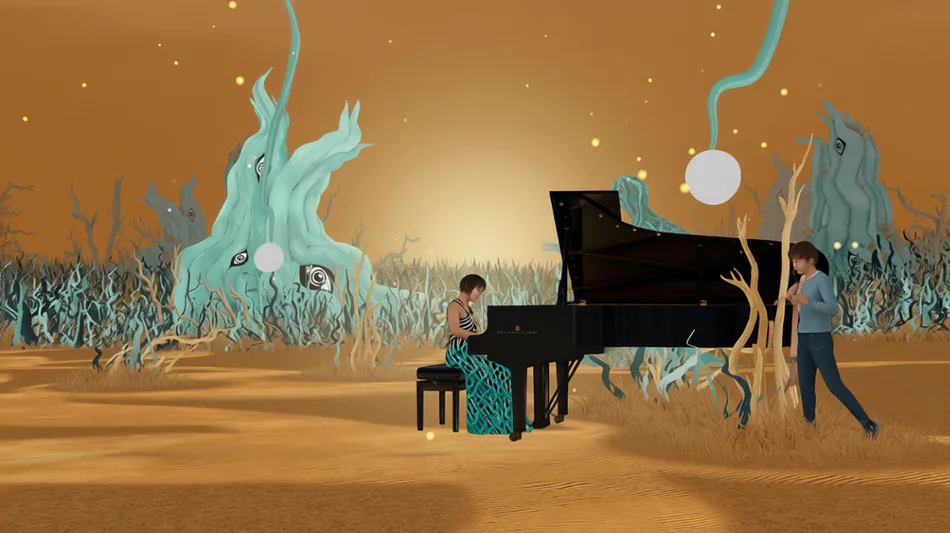
Grammy Award-winning pianist Yuja Wang has launched "Playing with Fire," a virtual reality installation at London’s Southbank Centre. Running until January 3 at the Royal Festival Hall, the project combines her musical performances with immersive digital environments designed to introduce classical music to younger and new audiences.
Grammy Award-winning pianist Yuja Wang has launched "Playing with Fire," a virtual reality installation currently on display at the Southbank Centre in London. The project, which runs until January 3 at the Royal Festival Hall, combines her musical performances with an immersive digital environment designed to introduce classical music to younger and new audiences.
The experience was developed by an international team of creatives and technical engineers from France and Iceland. Key contributors include Pierre-Alain Giraud, who won Best Immersive Work at Cannes in 2024; Nicholas Becker; Antoine Martin; Gabriela Fridriksdottir; along with the companies VIVE Arts and Atlas V.
Visitors enter a physical room containing approximately twenty other participants and a Steinway Spirio self-playing piano positioned on a circular platform. The space features bold graphics reminiscent of artist Mr Doodle’s black-and-white displays. Artistic director Pierre-Alain Giraud designed the physical setting to facilitate a gentle transition from the real world into the virtual reality environment.
Participants are instructed to wear headsets and walk freely around the room, with the warning not to touch the piano. The system detects proximity to the instrument: as users move closer to the Steinway Spirio, the digital presence of Yuja Wang and her playing become more vivid and realistic. Once the experience begins, users are immersed in a surreal landscape inspired by the "fiery nature" of the pianist.
The audio component features nine pre-performed pieces selected by Wang to evoke the sensual nature of childhood, as well as the creative, warming, and potentially destructive energy associated with fire. The repertoire includes works by Ravel, Debussy, Stravinsky, Bach, Franz Liszt’s "Feux follets," Prokofiev, Brahms, and Chopin.
The visual journey begins underwater, where users walk through a deep sea environment surrounded by swimming creatures. Other visitors appear in the virtual space as strange, skittle-like chess pieces that mutate in form, shifting from glass-like structures to dark pillars or vine-like forms. The piano and Wang’s image appear below the viewer, initially out of reach.
As participants attempt to move closer to the piano, the landscape evolves through various environments, including desert-like terrains, sky-like expanses, and mountainous regions. Gaudí-esque towers rise up before being consumed by fire. Large moons transform into giant octopuses, and drones appear in the distance. The experience also features phoenix imagery, giant primordial masks, and strange humanoid creatures encircling the viewer.
The intensity of the visuals can create a sense of vertigo, making movement difficult for some users. One observer noted that while they were admiring the visual feast and marveling at the technical achievement, the sheer force of the imagery made it difficult to fully hear the music. The experience is described as unique to each individual; one visitor reported seeing jellyfish, while a companion saw dolphins.
Wang has stated that the project is "a dream come true." The primary aim of the installation is to shatter traditional perceptions of classical music and prove that the art form can be dynamic and accessible. However, concerns have been raised regarding accessibility, with suggestions that ticket prices need to be lower to fully realize this goal.
The Southbank Centre describes the event as more of a show than an exhibition. Visitors are advised to arrive before their allotted time to secure a spot. The installation is part of a broader effort to engage audiences through immersive orchestral experiences, following previous successful presentations by the London Philharmonia at the venue.
I.Chauvin--PP