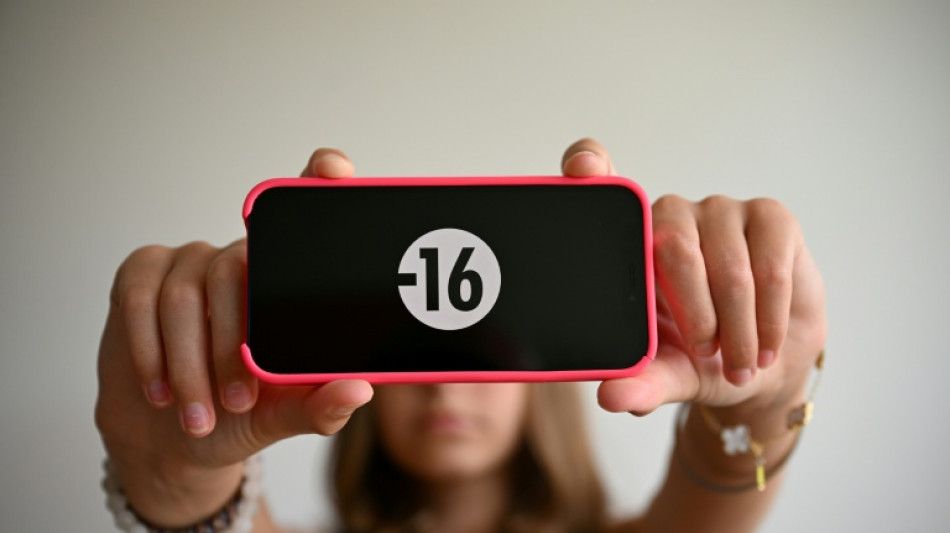
EU moves closer to kicking kids off social media / Photo: Nicolas TUCAT - AFP



Restrictions on children's use of social media in the European Union could come as early as this summer, as a long-awaited expert report next week is expected to recommend limiting minors' access to online platforms.
After Australia became the first country in the world to ban under-16s from social media, several EU nations including Denmark and Greece demanded a similar move.
The EU says all options are on the table, from a blanket ban on children from social media platforms to restrictions on certain services and features.
It appears there is little appetite for a broadbrush approach and EU officials insist no decisions have been taken before the panel tasked by EU chief Ursula von der Leyen delivers its recommendations on July 13.
Von der Leyen has indicated in the past she supports restrictions, with a formal announcement expected in September -- although that could change.
"It is not the question when children or teenagers would have access to social media, I would say it's more the question when social media has access to our children and teenagers," she said last week.
She is under pressure as some European capitals including Paris have already drawn up their own legislation, although Brussels on Monday told France to amend its draft law since it encroached on the European Commission's powers.
The EU says it will do more to protect children online -- not just on social media.
"Whatever decisions are made on age limits, we must also tackle the business models and design choices shaping children's online experiences every day," EU consumer protection commissioner Michael McGrath told AFP.
- Risk-based limits? -
The panel is not expected to recommend a blanket social media ban either.
For an idea on what to expect, observers point to a German panel that put forward two options last month: a statutory minimum age of 13 -- which many platforms have -- or restrictions on individual services and features.
The European Commission, the EU's digital watchdog, has been closely watching how the ban unfolded in Australia -- where there have been challenges -- and could opt for a different approach.
Brussels could take a risk-based approach, prohibiting features it views as harmful rather than banning platforms like Instagram, Snapchat or TikTok.
Bans have been growing in popularity worldwide, with Britain and Indonesia taking similar steps. Many EU states like Greece and Spain have also prepared their own bans, though Estonia fiercely opposes such a move.
A majority of Europeans surveyed in France, Germany, Italy, Poland, and Spain, for a YouGov poll published on Thursday want platforms to remove "harmful" design features like endless scroll and personalised content feeds.
Digital rights experts say bans are not the right way to go, arguing the EU should instead make platforms safer for children with the legal armoury it has.
"We don't think that exclusion is the answer. We need to enforce our existing laws," Simeon de Brouwer of digital rights group EDRi told AFP, adding he hoped new strengthened consumer protection rules would be "ambitious".
McGrath said the new law expected later this year would "recognise children as vulnerable consumers" and that minors "must be protected by design".
- 'Responsibility lies with platforms' -
Such steps are backed by Europeans.
The YouGov poll found 75 percent of the over 5,100 adults surveyed said platforms should be inaccessible to minors until they can prove they are safe.
"We must focus on measures that ensure the responsibility lies with the platforms to prove their products are safe before they can be used by children, or anyone," Michiel van Hulten, EU director at Reset Tech, said.
The EU has a significant legal weapon in the form of an online content law that forces the world's biggest platforms to ensure harmful and dangerous content is swiftly removed and bans targeted advertisements to children.
But de Brouwer said the EU was "timid" about enforcing the law. While the EU told Chinese-owned TikTok to change its "addictive design", it has only told US-based Meta to enforce age verification, he said.
An EU official told AFP, however, the commission is set to issue findings against Meta's Facebook and Instagram in a probe looking at how their services may cause addictive behaviour in children before the summer ends.
N.Rolland--PP