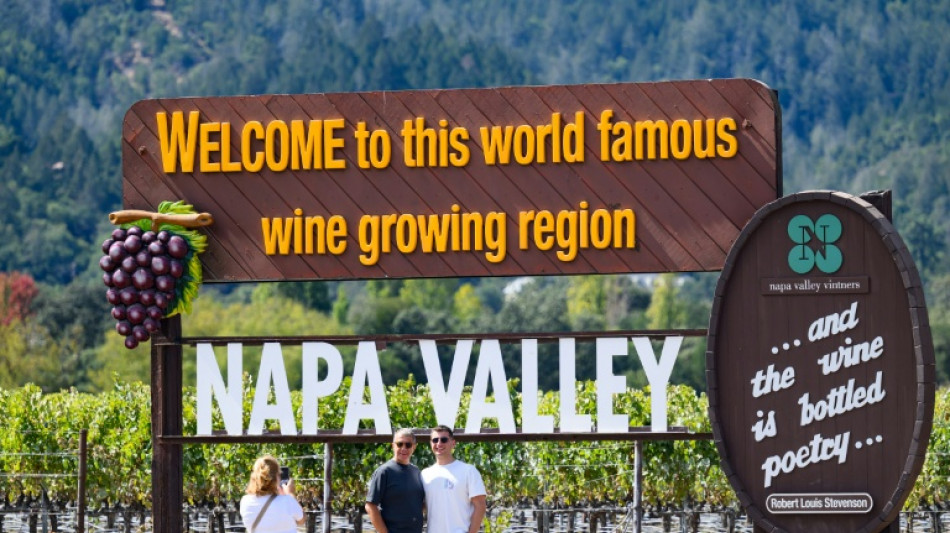
Napa Valley's wineries feel Trump's tariff squeeze / Photo: Josh Edelson - AFP


Napa Valley rocketed to international fame when its vintages shocked French rivals in a high-profile blind tasting contest that instantly turned the California corner into a wine-lovers' destination.
Now, Donald Trump's unpredictable tariff policies and attacks on traditional allies are souring the area's relationship with the foreign tourists and international markets it has grown to depend on.
"Napa Valley is proudly one of the most global, if not the most global destination in the United States for wine," Linsey Gallagher, president of Visit Napa Valley, an organization representing the region's hotel industry, told AFP.
"But at the moment that piece of the business is a little bit challenged."
Napa announced itself to the global wine-drinking public in dramatic fashion in 1976, when two of its vintages, a red and a white, won the Judgment of Paris, a blind tasting judged by nine experts, most of them French.
"Napa did not have any publicity, and then all of a sudden, the few journalists wrote articles, and Napa became a buzzing place," said Ivo Jeramaz, whose uncle, Mike Grgich, made the 1973 Chateau Montelena Chardonnay that was named best white at the competition.
"The wealthy clients started coming, money started pouring in."
The region boomed, said Jeramaz, who now runs Grgich Hills Estate, and spends hours talking with visitors who come to taste his wines.
But the excitement of the last few decades has cooled, he said, a situation exacerbated by tariffs that the US president has imposed on countries that buy California wine.
"Nobody is benefiting from tariffs," said Jeramaz, who blames them for raising production costs and hurting exports.
"We were selling over 1,000 cases, which is for us a good amount of wine, to Canada, and now we have zero since tariffs. So it's a big problem."
Ottawa and Washington are locked in a deep trade dispute, exacerbated by Trump's frequent insults and claims that Canada will be taken over as a 51st US state.
In response, some Canadian provinces have pulled US goods from their shelves and tourists who would otherwise have headed south have voted with their feet and stayed home.
"It's a big, big hit," said Jeramaz.
- International component -
About 20 percent of visitors to the region used to come from abroad, drawn by a Mediterranean-style climate, tranquil vineyards and lively towns full of restaurants and fashionable shops. That share has fallen to eight percent.
"The biggest impact for us comes from the decline in Canadian visitors," said Gallagher.
In an effort to fill the gap, businesses have focused their advertising efforts on the domestic market.
The strategy appears to be working for now.
Last year the valley welcomed around 3.8 million people, up three percent from pre-pandemic tourism levels.
"But we're only going to be able to extract so much out of that domestic and local market. We won't fully recover until that international piece comes back," Gallagher warned.
- Wellness, Napa-style -
Changing consumption habits among younger generations are also weighing on Napa Valley, where more than 1,000 vineyards line a nearly 37-mile (60-kilometer) stretch traversed by a tourist train.
Winemakers are trying to understand and adapt to these new customers who care more about environmental and social justice practices than about brands.
"When we get our wines in front of younger consumers and tell them the story of how they're made, how the grapes are grown, that it is a living, breathing, beautiful agricultural product, they're excited to discover something new," said Ali van Zyl, owner of the Belong Wine Company label.
Another way to draw visitors is to highlight the valley's natural attractions and its food and hotel offerings.
Tourism managers hope it could reposition Napa as a destination for people seeking a healthy lifestyle.
"Sharing a bottle of wine is a lot different than taking a bunch of tequila shots," said Laura Gabriel, van Zyl's partner in the River Club tasting house.
"It is a natural product and it's a part of well-lived life, with hiking and being outdoors and cooking," said Gabriel. "That's the Napa form of wellness."
C.Chevalier--PP