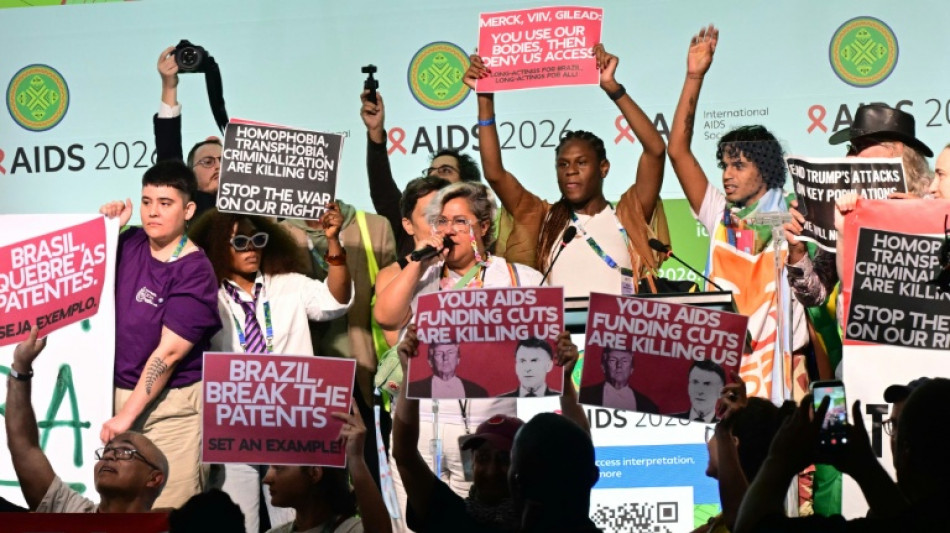
AIDS activists slam 'pharma greed' over breakthrough drug / Photo: Pablo PORCIUNCULA - AFP

Activists at a major AIDS conference in Brazil this week demanded wider access to generic versions of a breakthrough HIV prevention drug which can cost tens of thousands of dollars a year.
Despite participating in clinical trials, middle-income countries like Brazil, Argentina and Mexico have been excluded from access to a generic version of the drug, which researchers say can be produced for $40 a year.
Protesters burst onto the stage at the opening of the 26th International AIDS Conference in Rio de Janeiro bearing signs reading: "Pharma greed is killing us," and "You use our bodies then deny us access."
"How can Latin America still be left outside licenses for life-saving drugs? It is an injustice," said UNAIDS chief Winnie Byanyima.
The drug lenacapavir, which is injected twice a year, reduces the risk of HIV transmission by almost 100 percent and has been hailed as a game-changer for a disease which has killed over 40 million people in four decades.
Daily pills to prevent HIV transmission have been available for over a decade, but patients battle stigma in accessing them and must remember to take the medication.
While Latin America is one of only three regions in the world where new HIV infections are rising, pharmaceutical companies consider many countries too wealthy to benefit from generic versions aimed at low-income nations.
"This is unacceptable because many of the trials have been conducted in this region, and the pharma companies are forcing these countries to pay very high prices" for the drug, Antonio Flores, an infectious diseases physician at Medecins Sans Frontieres, told AFP.
Gilead Sciences, which owns the patent for lenacapavir, sells it for around $28,000 per patient annually -- for two injections -- in the United States.
Jared Baeten, a senior vice president at Gilead Sciences, told journalists on Tuesday that the company was offering -- with donor help -- three million doses of lenacapavir while generic manufacturers prepare production.
These are mostly going to low-income countries in Africa.
Baeten said Gilead had signed royalty-free licences with six generic manufacturers which can produce the drug for 120 countries.
He said 600,000 people will be on lenacapavir by the end of the year.
Byanyima has called for 20 million people to receive the drug, pointing out that around four billion Covid vaccines were rolled out in just over a year.
The president of the International AIDS Society Beatriz Grinsztejn, who led Brazil's participation in the clinical trials, told AFP that while the rest of the country has to wait, those who took part would be guaranteed ongoing access to the lenacapavir.
"Otherwise, as researchers, we'd be acting unethically."
K.Marchand--PP