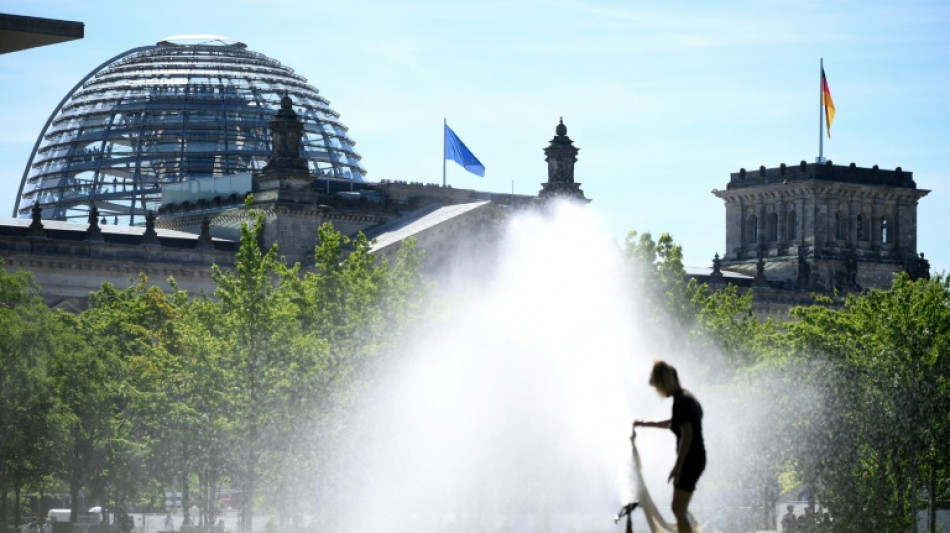
Events cancelled, records loom as heatwave reaches Germany / Photo: RALF HIRSCHBERGER - AFP



A heatwave sweeping Europe was starting to peak in Germany on Thursday, with several open-air events cancelled and temperatures expected to top 40C through the weekend.
Large parts of the country are already under "severe to extreme heat stress", the German Weather Service (DWD) said.
In the south-western town of Kirrlach temperatures reached 39.0 degrees on Thursday, according to provisional data from the DWD, just shy of the all-time June record of 39.6 set in 2019.
Experts say that record could easily be broken over the weekend.
In an unprecedented step, rail operator Deutsche Bahn warned customers to avoid travel and said it would refund any tickets booked up to June 30 due to a high risk of disruption from wildfires, heavy summer rain and thunderstorms.
Several open-air sports events have been cancelled, including a half-marathon in Hamburg where authorities cited the risk of "an increased demand for emergency and rescue services".
The mercury will rise further in Germany starting Friday and on Saturday, when almost the entire country is forecast to bake under temperatures of 35 to 41C.
Germany is not prepared to cope well with extreme heat, Martin Herrmann, head of the German Climate and Health Alliance, told AFP.
"Although public awareness of the dangers of heat has clearly increased, Germany is still poorly prepared, or not prepared at all, for a heat-related disaster," he said.
Herrmann called for heat protection to be more firmly embedded in disaster and crisis management, "like flood protection".
On Thursday the Berliner Stadtmission charity was handing out kits with water, food and suncream to the homeless, "the first victims of the climate crisis", according to charity spokeswoman Barbara Breuer.
"It's very difficult to move around in these temperatures," 52-year-old homeless man Christian Bernardt told AFP while taking shelter from the heat at a Stadtmission-run centre.
Hot weather over the past week has already led to a spike in fatal swimming accidents.
Two men aged 20 and 22 drowned in lakes in Bavaria, and a 79-year-old woman died in the Baltic Sea. Other fatal swimming accidents occurred in lakes in Brandenburg and North Rhine-Westphalia.
An investigation has also been launched after three teenagers died after swimming in a canal in North Rhine-Westphalia.
The risk of forest fires is also rising sharply, according to the DWD, with the highest alert level already reached in parts of eastern Germany.
D.Moulin--PP