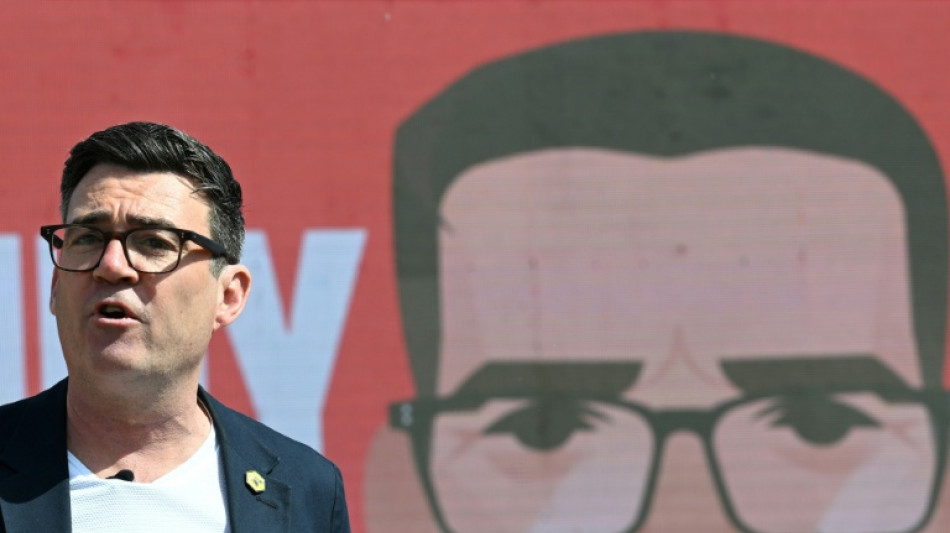
Andy Burnham: 'King of the North' eyes Downing Street throne / Photo: Paul ELLIS - AFP
Fresh from his UK by-election victory last week, veteran Labour politician Andy Burnham took another step Monday towards his long-held dream of moving into No. 10 Downing Street.
And everything points to it being third time lucky for the man touted as succeeding Keir Starmer to be Britain's next prime minister.
Seen as representing the Labour party's "soft left" and a pro-business socialist, Burnham has twice sought the party leadership, losing out to Ed Miliband in 2010 and Jeremy Corbyn in 2015.
He first entered parliament in 2001, and held senior cabinet posts under prime ministers Tony Blair and Gordon Brown.
He quit parliament in 2017 to run for mayor of Greater Manchester, where three successive election victories and his staunch defence of the region have earned him the nickname "King of the North".
He has described his campaign to return as MP and challenge Starmer as "a final chance to change" the Labour party.
Following his decisive victory in a key parliamentary by-election in northwest Makerfield, he vowed to "ensure the places Westminster has neglected will now get fairness".
After being sworn in Monday as an MP, he greeted supporters in Westminster Hall with a fist pump and snapped a selfie in front of a group of around 200 Labour colleagues.
- 'Feely, touchy' -
Andrew Murray Burnham was born in 1970 into a working-class family in Aintree, near Liverpool, and grew up in the village of Culcheth in nearby Cheshire.
Now 56, the loyal Everton football fan enjoyed the "Madchester" party music scene of the late 1980s and early 1990s.
He joined the Labour party as a young teenager before studying English at the University of Cambridge, where he said he often struggled with "imposter syndrome" because of his working-class background.
Recently, he has openly opposed Starmer, who resigned on Monday, over welfare cuts and warned of a "climate of fear" in the party, urging him to put forward a more left-wing vision for Labour.
In the past decade, Burnham has emerged as one of Britain's most recognisable regional leaders.
"When you're a mayor, it's very focused on an area, and balancing it within a country might be a bit of a challenge, but I hope he does a good job," broadcast engineer Aaron Wear, 23, said in Manchester.
Starmer's most recent Manchester mayor re‑election bid, in May 2024, saw him resoundingly returned to helm the city-region of 2.8 million people with nearly two-thirds of the vote.
He has pushed an agenda centred on public transport, housing and public health.
But so far he has remained "rather vague" on his plans for tackling the UK's cost-of-living crisis, said Tony Travers, a professor at The London School of Economics.
"It's sort of vibes -- feely, touchy -- and he's a good communicator, but rather less detail on what would change," he told AFP, adding he believed Burnham was "not much further to the left than Starmer".
- 'Manchesterism' -
Previous Conservative prime minister Boris Johnson issued Burnham a warning: "The clock is ticking, your honeymoon will not last long."
"You will be full of brilliant ideas for levelling up your country. You will have a wonderful agenda for them," but "some asteroid will hit you, like Covid or something," Johnson said Monday at a London conference.
Burnham leapt to national prominence during the Covid pandemic, clashing publicly as Manchester mayor with Johnson over lockdown funding for northern England.
The standoff cemented his reputation as an outspoken defender of regional autonomy.
He even has a worker bee tattooed on his arm, the long-standing symbol of Manchester.
Now Labour is hoping Burnham can help staunch the rise of the hard-right Reform UK party.
The first test will be the vote for the new mayor of Manchester next month, which Reform leader Nigel Farage is already eyeing.
"If the Labour party can hold on, that will be evidence that Burnham, at least now, has a sort of magic touch politically, that he can stop Labour voters defecting to Reform," said Travers.
Burnham, who is married with three children, has termed the phrase "Manchesterism", which he called "business-friendly socialism", as a response to "the high-inequality, low-growth trap" that he says dominated in the 1980s.
But Travers warned: "The UK can't tax itself much more, can't borrow much more, there isn't much growth. That means little room for manoeuvre."
"I guess it's good to have a Northern voice in Number 10," said Louis Marks, 30, who works in financial services in Manchester.
But if Burnham becomes prime minister, "he's got to deal with a lot of very big national issues, like the cost of living."
B.Fabre--PP