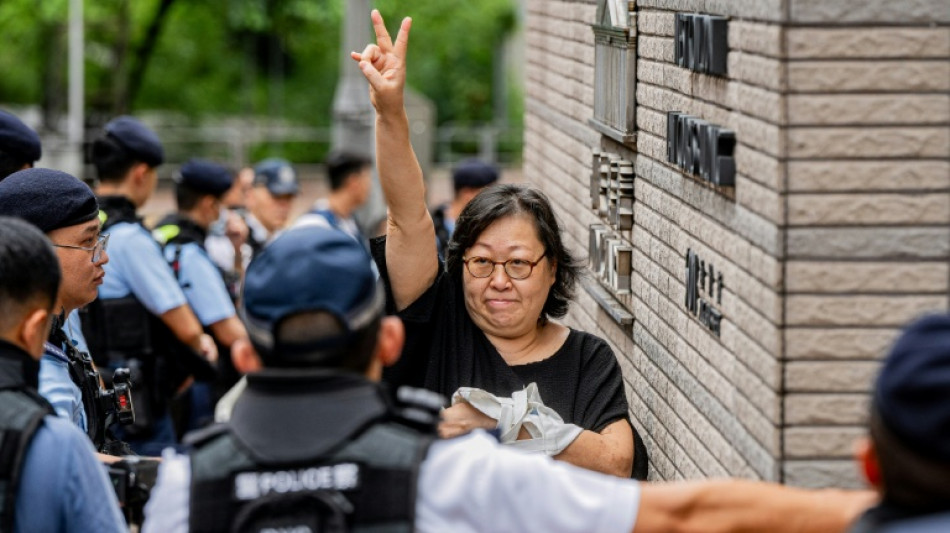
Hong Kong Tiananmen activists to receive national security verdict / Photo: Leung Man Hei - AFP
A Hong Kong court will deliver a verdict in the national security trial of two pro-democracy Tiananmen activists on Friday, in a case widely criticised as exemplifying the erosion of freedom of expression in the Chinese city.
Lee Cheuk-yan, 69, and Chow Hang-tung, 41, who organised candlelight vigils to mark Beijing's deadly 1989 Tiananmen crackdown, are standing trial for "incitement to subversion".
The pair face a maximum penalty of 10 years in jail if they are convicted by the three-judge panel on Friday morning.
Prosecutors have argued the defendants "endanger(ed) national security in the name of human rights". Chow, who represented herself, told the court in May that the law itself was on trial.
Hong Kong and Macau were formerly the only places on Chinese soil that permitted public vigils to mourn those killed on June 4, 1989, when Beijing sent troops and tanks to crush protests calling for political reform in and around the capital's Tiananmen Square.
Lee and Chow were leaders of the now-defunct Hong Kong Alliance, the group that organised annual vigils in the city's Victoria Park.
However, public commemoration has been effectively banned since Beijing imposed a national security law on Hong Kong in 2020, following huge and sometimes violent pro-democracy protests the year before.
The Alliance's leaders were charged in 2021 and have been behind bars since.
Dozens of police officers gathered outside the courthouse and ushered reporters away as they stopped to film audience members queuing outside before the hearing began on Friday, AFP journalists saw.
Former Alliance member Tang Ngok-kwan told reporters he was not allowed to enter because he had brought old newspaper articles and bookmarks related to the June 4th movement with him, and was stopped and searched by police.
Rights group Amnesty International has said Lee and Chow's case "relies on vague, overly broad and arbitrary definitions of 'subversion'".
Legal scholar Michael Davis told AFP the vigils "had become a collective activity that symbolised Hong Kong's rich tradition of popular protests".
"Much as the Jimmy Lai case sent a message of severe repression to the media, this case will send a similar message to speakers who want to exercise their freedom of expression through the vehicle of popular protests," he added.
Media tycoon Lai, founder of the now-defunct pro-democracy Apple Daily newspaper, was sentenced to 20 years in prison in December for foreign collusion and seditious publication.
Lee and Chow's trial began in January and took place over 24 days.
A third defendant, 74-year-old former lawmaker Albert Ho, pleaded guilty in January.
- 'Intention to incite' -
The Hong Kong Alliance was founded in May 1989, with key tenets including "building a democratic China" and "ending one-party rule".
Prosecutors said the two leaders' remarks over the years were not merely an expression of personal opinions, "but were intended to incite others to commit unlawful acts".
Lawyer Erik Shum, who represents Lee, argued that the right to criticise state organs is protected by China's constitution.
The Alliance's denouncing of the Chinese Communist Party's authoritarianism amounts to "a form of freedom of criticism", he said.
Shum argued that the prosecution provided no evidence that the group had incited people to take action to topple the party using "unlawful means".
Chow, a barrister-turned-activist, told the court that "sooner or later the law will have to confront the fundamental contradiction between dictatorship and the rule of law".
Friday's verdict "will be a significant indicator of how far courts are willing and able to interpret broadly drafted national security offences in a way that is compatible with fundamental rights and freedoms", Urania Chiu, a law lecturer at Oxford Brookes University, told AFP.
Hong Kong authorities had arrested 415 people for various national security crimes by the start of August, with 185 of them convicted.
H.Lecomte--PP