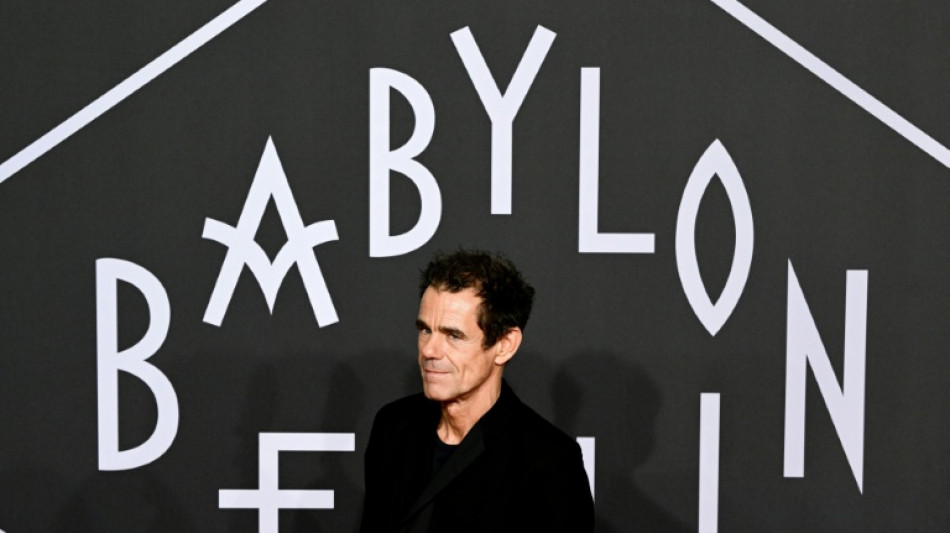
Series finale of 'Babylon Berlin' offers dark mirror for today's Germany / Photo: John MACDOUGALL - AFP/File
The hit TV series "Babylon Berlin" has captivated audiences by portraying the chaos and excitement of Weimar-era Germany, but the dark shadow of Adolf Hitler's rise to power will bring down the curtain on the show's upcoming final season.
Season 5 will debut online in Germany at a time when many are fretting about the rise of the far-right Alternative for Germany (AfD) party, which scored a breakthrough victory in a state election last Sunday.
The timing is "pure coincidence," insisted the directors behind the programme, Tom Tykwer, Achim von Borries and Henk Handloegten.
But viewers and critics are still certain to draw uncomfortable parallels and resonances in the gritty hit drama from public broadcaster ARD.
Inspired by crime novels from German author Volker Kutscher, the big-budget series is set against the backdrop of the final years of the Weimar Republic, Germany's 14-year experiment in democracy.
The era, sandwiched between the end of World War I and Hitler's ascent, was a period of liberal social attitudes, rapid technological progress and cultural achievement.
But it was also a time of economic hardship, inflation and deep political polarisation worsened by the humiliation of military defeat and the Great Depression.
Broadcast in 140 countries, the show chronicles the investigations and romances in Berlin of Gereon Rath -- a young police inspector from Cologne traumatised by World War I -- and his partner Charlotte Ritter, a young Berliner from a modest background who dreams of a career in law enforcement.
- Rise of extremes -
The final run of "Babylon Berlin", which will premiere on Thursday at a red-carpet event in Berlin's famed Zoo Palast cinema, does not yet have an international release date.
Since the show first aired in 2017, the directors have focused the narrative on the final four years of the Weimar Republic, from the global crash of 1929 to Hitler's seizure of power in 1933.
Tykwer, also known for films such as "Run Lola Run" (1998) and "Cloud Atlas" (2012), said the show's creators did not necessarily set out to create a parable of our own times.
"We were drawn to these themes even before the major upheavals in Europe and globally," said Tykwer.
The director said they were surprised when the historical drama began resonating as democracy in Germany and around the world faced a crisis of rising nationalism and mounting voter distrust.
When work on the project began in 2013, the far right had no presence in the German parliament and the AfD had only just been founded as an anti-euro party.
It has since transformed into an anti-immigration party and radicalised, with opponents regularly accusing it of racism, collusion with neo-Nazi extremists and ties with Vladimir Putin's Russia.
The AfD has also steadily grown in popularity, entering parliament in 2017 and finishing second in the most recent national election in February 2025.
The party now routinely leads national opinion polls, well ahead of Chancellor Friedrich Merz's centre-right CDU/CSU bloc.
- 'Vulnerability' of democracies -
Tykwer, in an interview with AFP, said "Babylon Berlin" reflects the "vulnerability" of democracies "and how quickly they can be brought to collapse by radical aggression, despite having been built up with such care over such a long period".
"We were drawn to these themes because they touch on something deeper and universal: the struggle between peaceful, empathy-based systems and the forces capable of destroying them."
But Tykwer and von Borries said the show is not intended to deliver any kind of clear message to voters ahead of further regional elections later this month.
But Handloegten expressed pride in having "struck a chord that truly resonates" with viewers around the world who also find themselves -- and their countries -- at a political inflection point.
"I think we took a clear political stance, especially in this final season, and that seems very necessary to me," he said.
For Handloegten, the pressures facing democracy in many countries where the series airs "were truly a source of motivation" during the show's lengthy run.
"I felt there was a contemporary relevance to it, so for me, the work we've been doing here for 13 years is, in a strange way, political."
P.Breton--PP