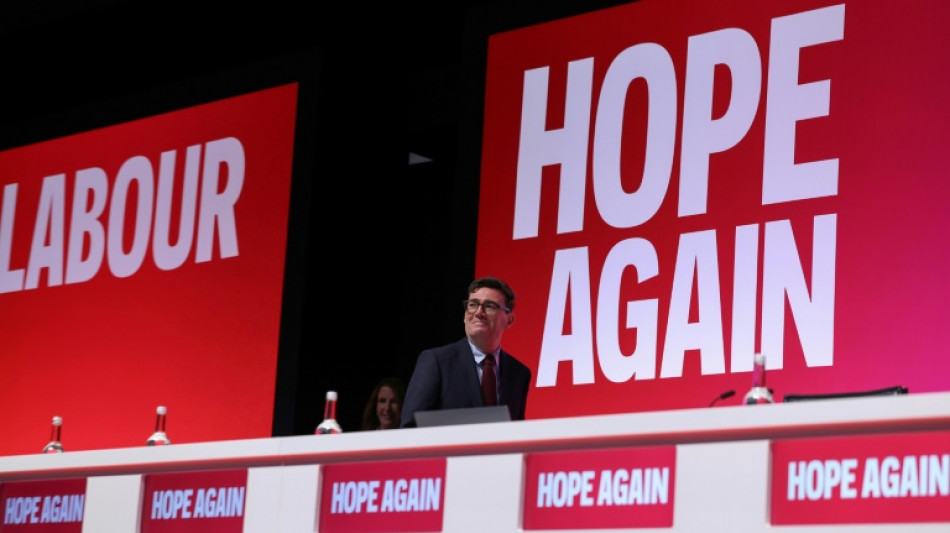
UK Labour party meets buoyed by Burnham but seeking concrete plans / Photo: Darren Staples - AFP

Britain's ruling Labour Party Sunday launched its first annual conference under Andy Burnham's leadership, bouyed by his debut as prime minister as he pledged to take the tough decisions needed to tackle looming challenges.
The former mayor of Manchester has injected new life into the centre-left party since MPs propelled him into Downing Street in July after ending Keir Starmer's two-year premiership.
In an interview from the conference in northwestern Liverpool, Burnham pledged to show in his speech Tuesday that he will not shy away from taking hard actions.
Burnham told the BBC that people would "see that I am prepared to take those type of decisions because I won't do what the previous Conservative government did and take risks with the economy that actually are still hurting us right now".
Burnham's higher personal approval ratings, coupled with difficulties facing rival hard-right Reform UK, have helped Labour enter the conference ahead in some opinion polls.
That is a sharp turnaround from the start of 2026.
- 'Breathing space' -
As the conference got underway, police arrested a number of demonstrators outside during a protest in support of banned group Palestine Action.
The prime minister was also being kept informed about an incident in southwestern England near an air base used by the US Air Force.
An army bomb disposal team was on the scene and several men had been arrested on suspicion of explosives offences, police said.
Last year's Labour conference was overshadowed by talk that Starmer's days were numbered, while the 2024 edition followed criticism of several government policy decisions made soon after the party won that year's election.
Since becoming prime minister on July 20, just weeks after returning to parliament following a nine-year absence, Burnham has sought to give voters some "breathing space" from cost-of-living pressures exacerbated by the wars in the Middle East and Ukraine.
He has cut electricity bills, capped bus fares, and reduced business rates for pubs, clubs and live music venues.
Those measures, together with Burnham's active social-media presence, have helped strengthen his public image.
Burnham has also set up a "No. 10 North" office in Manchester as part of his plans to spur GDP by devolving more powers to cities and regions.
Surveys suggest that almost half of Britons view him favourably.
But he has so far said little about how he plans to fulfil pledges to end rough sleeping by homeless people, reform a ballooning welfare bill, fund a new social care service, reindustrialise the country and raise defence spending.
- 'Underlying anxiety' -
Former minister Tony McNulty served alongside Burnham in Labour governments of the early 2000s. He told AFP the premier had to start fleshing out a promised "10-year plan for Britain" during his keynote speech at the conference on Tuesday.
"Much of it might still be broad brushstrokes but he needs to start the process of putting meat on the bone.
"It needs to go beyond the TikTok and good vibes stuff," he said.
Labour MP Alex Sobel told AFP he wanted to hear "what we'll do to support" young people in terms of opportunities.
Some 981,000 people aged 16 to 24 are not in employment, training or education, statistics show.
Burnham has limited fiscal flexibility because of Labour's election-winning manifesto commitments to not raise income tax, national insurance contributions or value-added tax.
It makes finance minister John Healey's first budget on October 28 a difficult one.
Burnham has said he will use his speech to "say further about the direction I want to take the country".
"Let's focus on where we are and let's not get into a position where we've just got a narrative of doom about all of this," he told the BBC.
He said he was "very conscious" of the "febrile state of the global economy".
But the "fundamentals" of the British economy had been "moving in the right direction", until the Middle East war broke out, he argued.
A YouGov poll published Thursday put support for Labour at 24 percent and Reform on 22 percent, a dramatic turnaround from last year when Nigel Farage's anti-immigrant group enjoyed double-digit leads.
If an election were held tomorrow, Labour would lose its majority but would likely be able to lead a progressive coalition, the survey suggested.
"There's still an underlying anxiety about how long ... (Labour's) bounce will last given the very tricky fiscal situation the government is in," political scientist Tim Bale told AFP.
Y.Leger--PP