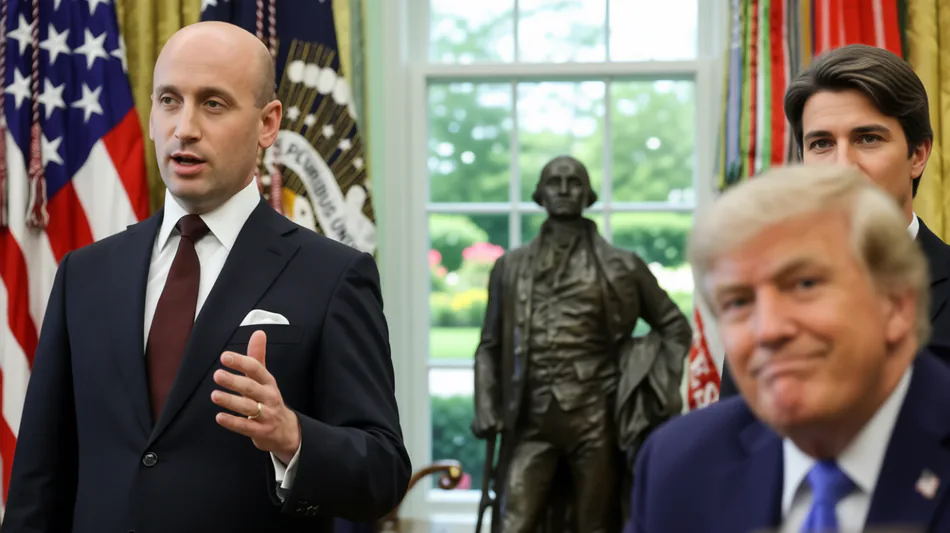
Trump Names Stephen Miller as Chief of Staff After Midterm Defeats



President Donald Trump has appointed Stephen Miller as his next White House chief of staff, marking a significant shift in administration leadership following Republican defeats in the midterm elections. The move replaces Susie Wiles and signals a return to aggressive policy enforcement as the party faces potential congressional investigations.
President Donald Trump announced on Friday that Stephen Miller, one of his most politically aggressive and powerful aides, will serve as the next White House chief of staff. The appointment follows a significant electoral setback for the Republican Party in the midterm elections.
Miller, who currently holds the titles of deputy chief of staff for policy and homeland security adviser, is set to take over from Susie Wiles on Monday. Trump confirmed the personnel change in a statement posted on his Truth Social platform, noting that Miller would assume the role less than a week after Republicans lost both the House of Representatives and the Senate.
The loss of congressional control represents a searing rebuke of Trump’s policy agenda. According to two sources familiar with the matter, Trump has privately blamed Wiles for what he considers the worst Republican midterm performance in decades. Wiles submitted her resignation on Thursday.
Trump reportedly considered three candidates to replace Wiles: special envoy Steve Witkoff, director of national intelligence Jay Clayton, and Miller. Sources indicate that Trump ultimately selected Miller due to his deep loyalty and zeal in defending the president, particularly as the administration faces the prospect of congressional investigations beginning next year. Miller has been with Trump since his first presidential campaign and remained loyal during his political exile in 2021.
Miller had signaled his interest in the chief of staff position for weeks, especially after Wiles endured negative media coverage suggesting her position was precarious. In recent months, Trump began excluding Wiles from certain decisions, further fueling speculation about her tenure. For instance, reports indicated that Trump hired Katie Zacharia as press secretary without consulting Wiles, a claim the White House has pushed back against.
With Wiles’ departure, White House aides are bracing for additional personnel changes. Sources suggest that Wiles’ deputies, including James Blair, who developed the GOP midterm strategy, and Richard Walters, may be vulnerable to dismissal by Miller unless they resign first.
The leadership change is also expected to benefit Defense Secretary Pete Hegseth, who has had a strained relationship with Wiles but is ideologically aligned with Miller. Last year, Hegseth and Miller worked closely on the Trump administration’s campaign of strikes against boats around Venezuela. As leader of the Homeland Security Council, Miller orchestrated that campaign through the Pentagon.
Wiles leaves the White House as arguably the most successful chief of staff in Trump’s history, having maintained his confidence from the start of his second presidential campaign in 2021. This contrasts with Trump’s first term, which was marked by frequent turnover in the role. Wiles faced significant challenges in recent months, including a successful course of chemotherapy and accusations that her daughter received lucrative contracts due to family connections to the president. Both the White House and Wiles’ daughter’s firm have denied these allegations.
In a statement on X, Wiles wrote, “Serving President Trump in the White House has been the honor of a lifetime. I’m so proud to have been a part of what we’ve accomplished together from securing our border and cutting taxes to strengthening our economy and putting America First.”
W.Aubert--PP