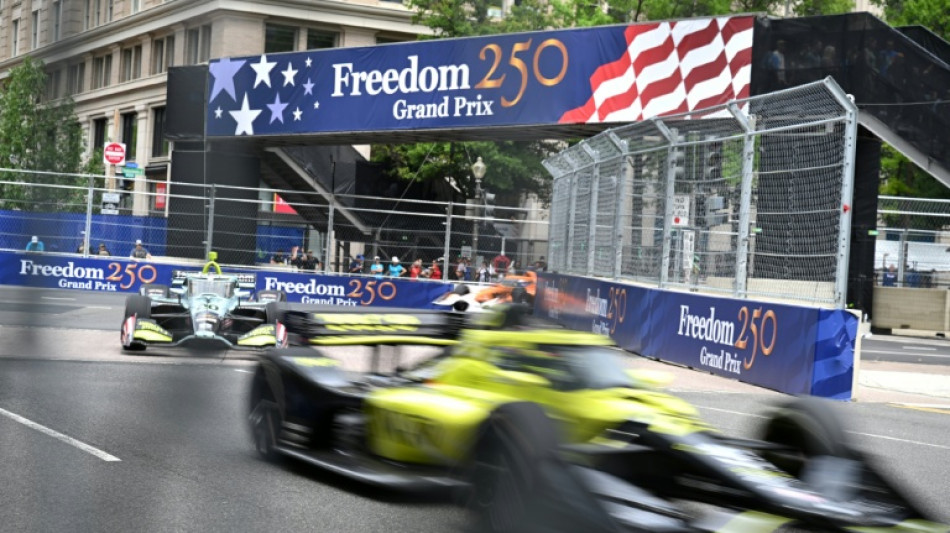
IndyCars zip among iconic Washington landmarks ahead of Freedom 250 / Photo: ROBERTO SCHMIDT - AFP

Race cars roared across Washington city streets in the shadow of iconic landmarks on Saturday as the Freedom 250 Grand Prix, created by President Donald Trump, began with practice and qualifying for Sunday's first-of-its-kind event.
IndyCar drivers tested open-wheel vehicles at speeds up to 185 mph (298 km/h) over the bumps and curves of a seven-turn, 1.7-mile course winding around the Washington Monument, US Capitol, National Gallery of Art and Smithsonian's Air and Space Museum -- all along the National Mall.
"This is surreal for all of us drivers," said American Kyle Kirkwood, second in practice with a lap at 56.691 seconds. "The history, going around the museums, the monument, the Capitol building -- everything about this is something you dream about.
"Thirty years from now we're going to look back and realize that was one of the coolest races we've ever done."
Spain's Alex Palou, the season points leader who has won six times this year, captured his seventh pole position of the campaign with a qualifying lap of 56.899 seconds after topping practice laps at 56.614.
"Such a privilege to be racing here. Spectacular place," said Palou, who made a White House visit earlier this week. "To see the buildings we have around, the Capitol when you exit turn seven, it's just incredible."
Results, however, took a back seat to the epic backdrop for Sunday's race, which Trump created by executive order as part of celebrations for the 250th birthday of the United States.
"This is a once-in-a-lifetime event," said Bud Denker, Freedom 250 chairman and president of IndyCar owner Penske Corporation.
"The president and Cabinet members, they really made it happen," Denker said, citing work done in seven months that usually takes two years to complete.
Organizers expect up to 100,000 people to attend the race, Trump among them.
A field of 25 will compete Sunday over 147 laps for 250 miles, the second-longest street-course race in IndyCar history after 310-mile events in 1982 and 1983 at Cleveland.
"I can't think of a cooler setting when you're looking at the Capitol in the background," said Zak Brown, chief executive officer of McLaren Racing. "I'm already hoping there's a year two."
Pavement bumps on Pennsylvania Avenue just beyond the first turn, after a start-finish line at the US Capitol, and more bumps before turns two and six, where several cars clipped the padded concrete outer wall, taught valuable lessons.
"It's good to be racing here," France's Romain Grosjean said. "There's definitely a few more bumps, a bit less corners, but generally there are some really good flowing sections."
Precise handling to cope with the bumps will be vital, Mexico's Pato O'Ward said.
"There are certain ones that are right where maybe the car doesn't love it all the time. That's a little bit of probably what we're going to be working around," O'Ward said.
"You need to be quite aware of where to place the car. It's about getting all the small details right. I expect it to be a tough race."
- 'Spice things up' -
Palou said he would attack Sunday with intensity usually reserved for the Indianapolis 500 as he chases a fourth consecutive IndyCar season crown and fifth in six years.
"The race is going to be tough -- 250 miles, a long day. It's going to be rough," Palou said.
"Huge bumps heading into turn two and turn six, massive bumps that are going to spice things up.
"The bumps are so big, there's not much you can do. You need to have a car that's alright over bumps, that's not trying to kill you every time.
"Once it's manageable, you just need to go over them and try and make the car as fast as possible."
B.Fabre--PP